eLearning & Interactive Courses
PromptCraft
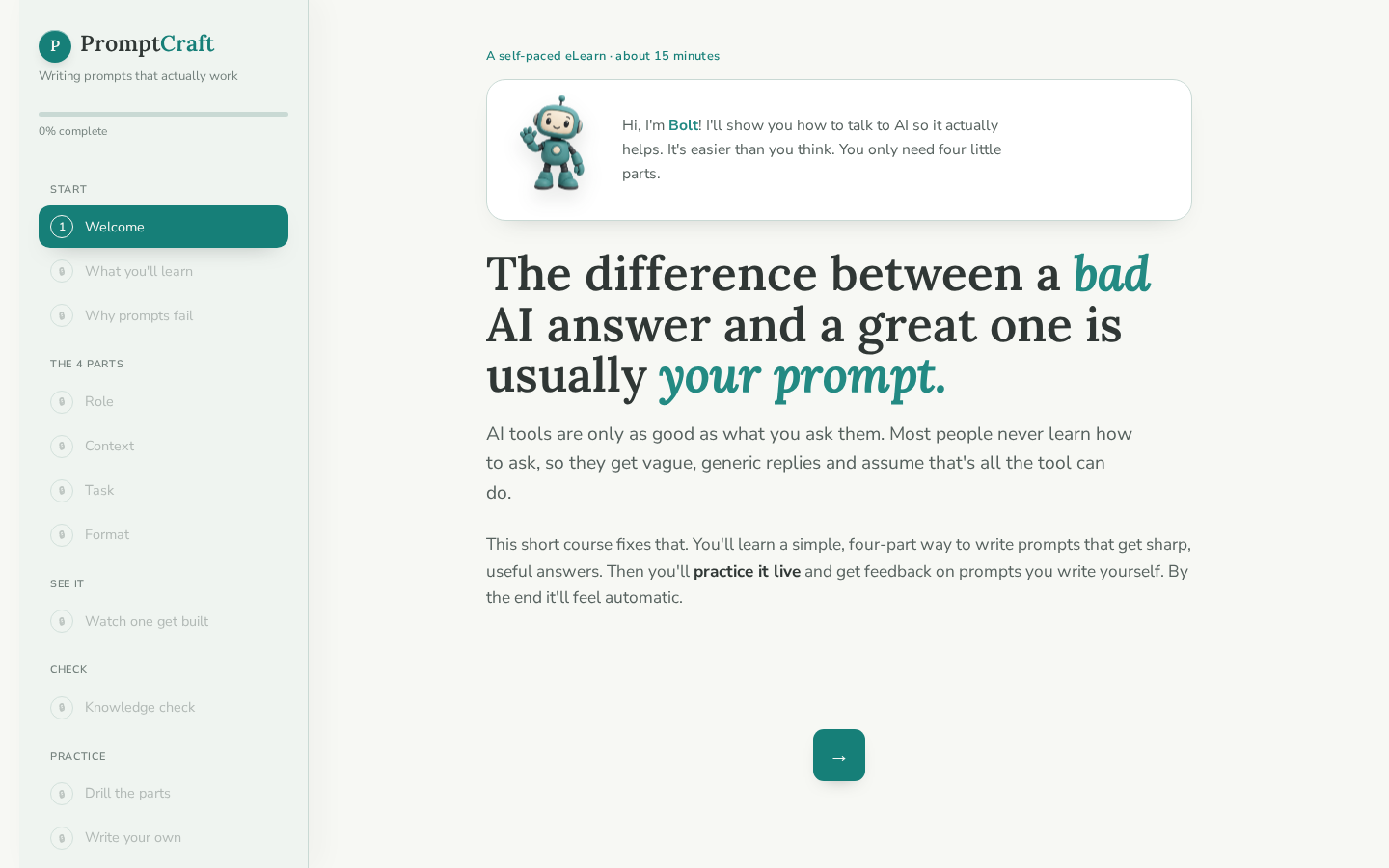
A 15-minute interactive course that helps everyday AI users turn vague requests into useful prompts through a memorable four-part framework.
About this project
The challenge. New AI users can receive generic answers when their prompts do not give the tool enough direction. I saw an opportunity to make effective prompting feel more approachable and repeatable for people using AI in everyday work.
My approach. I designed a self-paced experience around four prompt-building decisions: Role, Context, Task, and Format. Learners see each part explained, watch a complete prompt take shape, practice identifying what is missing, and then write and revise a prompt using criteria-based feedback.
The result. A complete interactive prototype that moves learners from explanation and demonstration to guided practice and independent application. The project has not yet been piloted with learners, so the next step would be testing its clarity, pace, and learning effectiveness.
Unlocking Your Periodontal Protocol
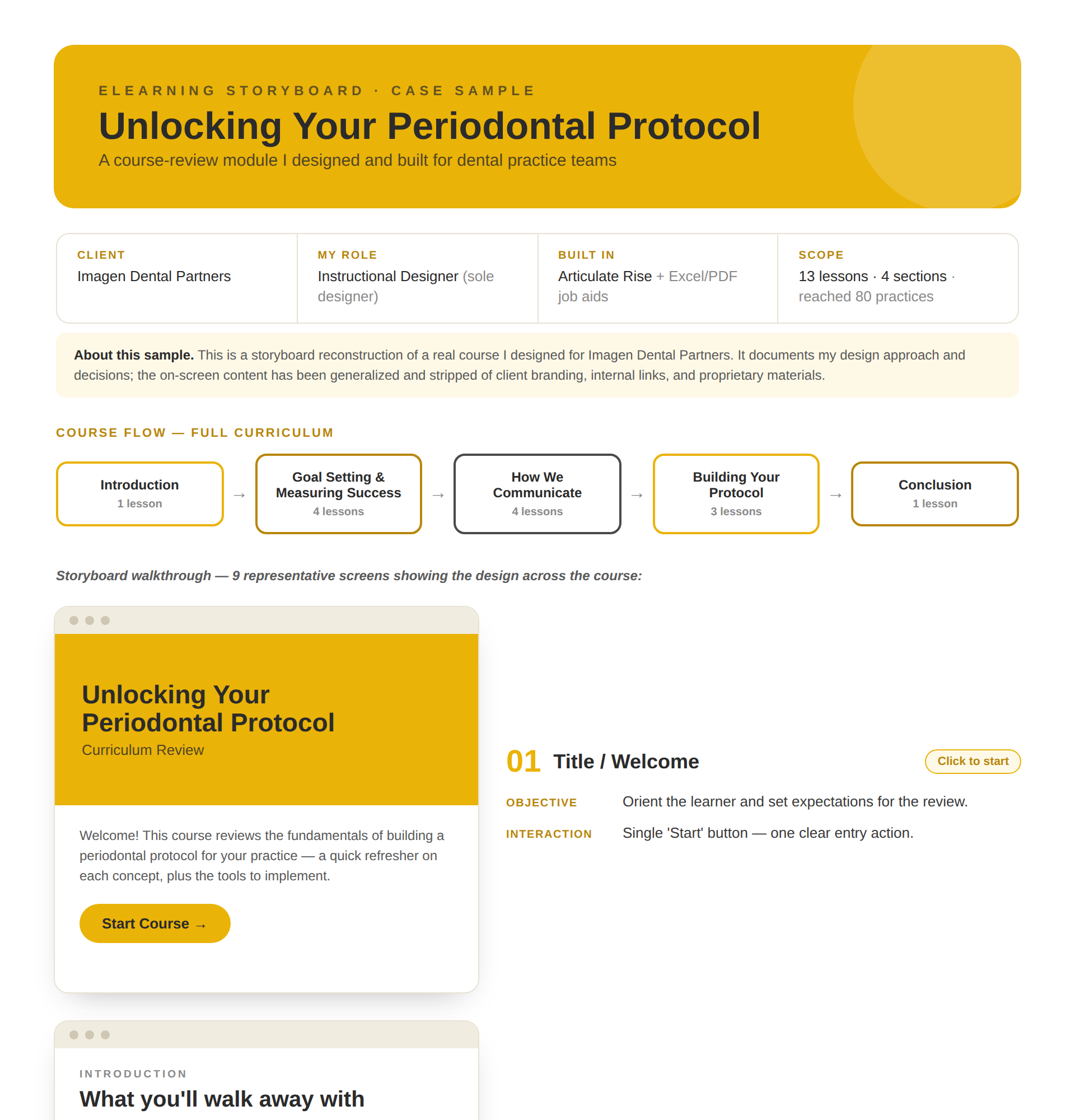
A 13-lesson course-review module for dental practice teams, refreshing each concept and giving teams tools to put it into practice.
About this project
The challenge. As dental practice teams worked on their periodontal protocols, there was an opportunity to give them a shared, structured way to revisit the fundamentals, goal-setting, patient communication, and protocol design, and to apply them back in the operatory.
My approach. I designed a 13-lesson self-paced module in Articulate Rise, structured as a guided review: each concept gets a focused refresher, an interaction or knowledge check to reinforce it, and a downloadable tool to apply it on the job. The storyboard shows how I planned each screen, including objectives, interactions, accessibility, and development notes.
The result. A reusable module that gave practices a shared foundation, pairing the learning with practical resources teams could use while implementing their protocol.
Representative sample — Recreated to demonstrate my design approach without sharing proprietary content.
Beyond the Discount
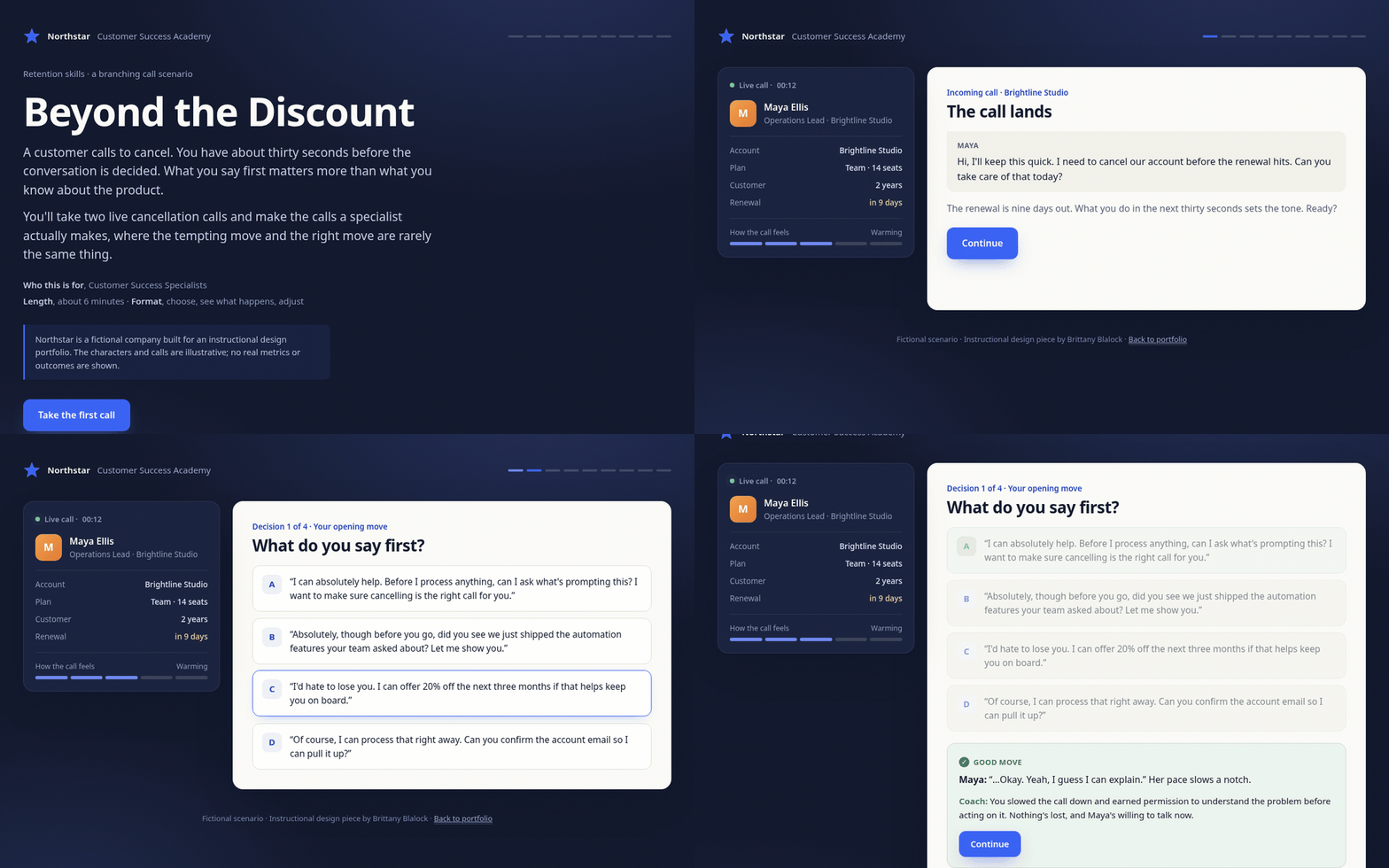
A fictional customer-retention call where learners make choices and see how the conversation unfolds, built as an experiment in AI-assisted prototyping.
About this project
The concept. I wanted to explore how a realistic customer scenario could become an interactive learning experience where learners make decisions and see how the conversation develops based on their choices.
How this was built. I created this as an experiment in AI-assisted prototyping. I gave Claude a fictional learning scenario, and AI generated the working interactive prototype in HTML, CSS, and JavaScript. I did not write the code. This gave me a way to see how quickly an initial learning idea can become something tangible enough to review and refine.
What I learned. A clear scenario and well-defined choices matter more than the technology. Getting to a working version early made it much easier to judge whether the practice felt realistic, and where it needed adjusting.